Showing posts with label Bangalore. Show all posts

Tuesday, June 18, 2013

The Bandstand in Cubbon Park

The bandstand in Cubbon Park is undergoing 'restoration', PWD style. Right now, the roof has been stripped off and only the iron pillars remain standing. It's a little upsetting, especially because INTACH spoke, nay begged, the Horticulture Department to restore the bandstand more than a year ago. They were very interested in it, and asked us to submit a proposal for its restoration, which we did. Some phone calls, some phone-tagging, some emails, some re-sending, more phone calls, and the next thing we know, it's been given to the PWD for restoration. Not that that is a bad thing necessarily, but the PWD's record in restoration does not exactly inspire confidence.

The bandstand is - was - a pretty interesting structure. There has been a bandstand in Cubbon Park since at least the 1870s, but not where it currently stands. In fact, the earlier bandstand was probably where the petrol bunk near Koshy's is today. It was demolished and a new one built at the current location sometime in the early 1900s. The one in Lalbagh was built in 1863. This is just two years after the world's first ever bandstand was built in Kensington in England. Like others built elsewhere in England's then colonies, Bangalore's two bandstands also probably use steel imported from Scotland's foundries.

Of course, the bandstands were built for bands to play music in, and indeed, the Cubbon Park bandstand has been the venue of hundreds of concerts. In the early days, it was military bands that played here. By the 1960s, people came here in their hundreds to listen to musicians and bands playing Kannada hit songs. But in the late 1970s, the crowds thinned and gradually, the music wound down. Some years ago, an NGO called Prakruthi managed to revive the musical tradition. For four years, the grounds around the bandstand once again echoed with music and laughter. But funds weren't forthcoming and the show couldn't go on. But they haven't given up hope. MS Prasad from Prakruthi told me, "We are waiting for the Bandstand's resurrection and will always strive to showcase talent and make it a heritage site." I hope his wish comes true.

You can read more about Cubbon Park's bandstand here.

Wednesday, August 22, 2012

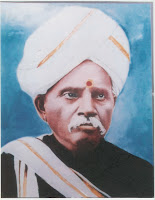
The RBANM behind the RBANM schools and colleges

I had the honour of meeting Mr TV Annaswamy some days ago. Anyone who is interested in the history of Bangalore would probably be familiar with that name - he is the author of Bengaluru to Bangalore: Urban History of Bangalore from the pre-historic period to the end of the 18th century, a comprehensive compendium of information on Bangalore f
rom numerous, varied sources. I went to meet him not because of his role as an author but because Mr Annaswamy is the grand-nephew of Rao Bahadur Arcot Narrainsawmy Mudaliar, i.e., RBANM.

I had long wanted to know more about this man RBANM who had lent his name to so many institutions and grounds in Ulsoor. So I started from his death. I knew from Wikipedia and here that he was buried somewhere on Veerapillai Street so one morning, a friend and I set off to look for his grave.

Addresses have changed. So have people. Most people we knew had no idea who we were talking about. We were variously directed to the RBANMS grounds and an old hamam (which I have to check out sometime). Even the people at the post office had no idea where the grave might be. Finally, it was a sardarji in a tyre shop who knew exactly what we were looking for and directed us to the spot (unfortunately, I forgot to ask him his name, nor do I remember the name of the shop).

The samadhi was inside a neat little compound in a corner of a huge cricket field, opposite what appeared to be a pay-and-use bathroom and what I presume was a warehouse. It was locked and neither the puzzled person at the warehouse nor the drunk watchman at the gate to the warehouse-bathroom area (and the samadhi) knew when it would be open. From the outside, I could tell that a shrine has been built around the grave, but since I have not yet gone back to check inside, I cannot tell you what it looks like inside the shrine.

I was disappointed with the samadhi, but not entirely surprised. Not one of the people we talked to in the area knew about it or seemed to care. It was lost inside and belittled by its inappropriate surroundings. Right outside its gates, all I could see were huge construction debris and paraphernalia like huge tin sheets. But at least there was a board and the samadhi itself seemed very neatly maintained.

But the samadhi had piqued my curiosity and I wanted to know more about RBANM. Enter Mr Annaswamy. Well, actually, I entered his office and immediately noticed all the yummy antique furniture. "Everything here is antique...including me," quipped Mr Annaswamy. He was a charming, helpful and soft-spoken person, and only too happy to talk to me about his ancestor. Being passionate about history in general, he has taken it upon himself to compile as much of his family's history that he can. "My family thinks I am a little mad," he said, smiling at his obsession.

Mr Annaswamy had retired as the Joint Director of Town Planning in
the GoK and had written a book that was highly regarded, but here he
was generously giving of his time to a paltry freelance writer. He talked to me about his collage, helped me with photographs and entertained all my questions. I couldn't help but admire his humility and grace. I learnt about how RBANM could hobnob with Bowring and Sankey but never forgot his nationalist spirit, how he never forgot the help that the Maharaja gave him, how he argued for entry to temples for everyone fo all castes, how he had believed that wealth was something that was meant to be shared.

At the end of the interview, I came back impressed by one man, inspired by the other.

Sunday, March 11, 2012

The original Lalbagh

It all started almost two years ago, when the National Gallery of Modern Art, Bengaluru asked INTACH to organise some walks in Bangalore to coincide with an exhibition they were having on artists of the 1700s and 1800s. One of the walks we did then was at Lalbagh Botanical Garden.
I've always loved going to Lalbagh (except perhaps on some weekends when you can barely see the trees for the people). Researching the history of the garden for the Parichay was fun - re-reading Tipu's letters where he asks for seeds from elsewhere, reliving Cleghorn's excitement over the Sultan's garden that was to become a botanical garden...
But we had chosen Lalbagh for the NGMA walk because in the eighteenth century, a lot of Englishmen who came to Bangalore - soldiers, draughtsmen, artists - seem to have been fascinated by the place. In the late 1700s, Europe was in the grip of the Picturesque movement, so when artistically-inclined chaps came and saw here a readymade picturesque garden, complete with mandatory ruin, it was but natural that they tried to capture its picturesqueness in their sketches. Robert Home, James Hunter, Robert Colebrooke and Claude Martin all sketched views of Lalbagh.
Spurred on by MBK, I tried to take a closer look at the paintings and at maps that we had for the same period...and was a little startled. Why, it looked like today's Lalbagh was not where the Lalbagh of the 1790s was. A couple of emails to colleagues and friends who are considerably wiser than I, some meetings, a few discussions, and several months later, we had put together a note which was later published in Current Science. Take a look. And the next time you go to Lalbagh, think about how different it once looked.

Thursday, February 16, 2012

Sankey and a letter

I have always wanted to write about Richard Hieram Sankey - he of Sankey Tank fame - someone who seemed to me to be an epitome of industry. In a few short years, he built so many of our most beautiful buildings, including the lovely St. Andrews Church and the stately Mayo Hall. And of course, he was responsible for Cubbon Park. Who in Bangalore has not communed with Nature when wandering the winding paths that lead through its bamboo thickets, or listening to the trill of a magpie robin on one of its many trees. What impressed me about him was that he was not just a regular PWD engineer whose job it was to build edifices. That he did, but he was also clearly so passionate about a great many
other things. Look at his paintings and it is immediately obvious that he was a keen observer of Nature. In fact, he was one of the first to raise his voice against indiscriminate tree clearing in Coorg. While involved in work on building roads and bridges there, the ever-observant Sankey realised that tree felling led to flooding. He also collected fossils and shells. Sankey's first wife, Sophie Mary, was the daughter of the noted malachologist William Benson. Was Sankey interested in shells even before he met Sophie, I wonder...


Nothing quite compares to the high that appreciation brings. A day after my article on Sankey appeared in Deccan Herald, the main paper carried a letter from a reader who liked the article. I confess I couldn't stop smiling all day!

Tuesday, March 22, 2011

Cannon and fodder at the Battle of Bangalore

It's been a while since I posted here, mainly because I have been travelling a lot. But I couldn't pass up writing about the Battle of Bangalore on its 220th anniversary.
Did you know there was such a battle? Why, our very own fort was at the heart of things then. Bastions and breaches, bullocks and the British, cannon and fodder, bayonets and betrayals: the Battle of Bangalore had all the drama, blood and gore associated with battles. It was a short battle, with the siege lasting only two weeks. But the consequences were pretty far-reaching, or at least I like to think so. After all, capturing Bangalore made the assault on Srirangapatna (and hence the eventual defeat of Tipu) possible. Here's more on the Battle in my article in Deccan Herald.

Monday, December 13, 2010

The granddaddy of inscriptions

Q: What do you call a man who was teacher, Principal, administrator (all before he turned 30), census officer, prolific author, historian, polyglot and archaeologist all rolled into one? A: The granddaddy of inscriptions, aka, Benjamin Lewis Rice.

There isn't a historian in Karnataka (amateur or otherwise) who has not repeatedly reached for books by Benjamin Lewis Rice, his best known being the Gazetteers and the many volumes of Epigraphia carnatica which carry translations of thousands of old inscriptions.

But the history of the man who uncovered so much of our history is also fascinating. School principal at 23, Inspector of Schools (for the whole state, mind you!) at 28, Director of Public Instruction (again, for all of Mysore) at 31.... I could feel feelings of inadequacy creeping up on me, reading about Rice! And what an adventurous life he led, full of the thrill of discovery! The man spent at least half the year on tour ferreting out historical relics and obscure inscriptions from all around Karnataka, braving cobras, disease and goodness knows what else along the way. Remember, this was the pre-automobile era so all touring was done on horseback, or ponyback to be precise, for Rice had a white pony that he took on all his tours.

He knew Kannada, of course, having been born in Bangalore, but he also studied Hindi and Sanskrit, and later picked up Tamil and Grantha when he found he needed these to study inscriptions.

You can hear Lewis Rice's love of all things related to Karnataka's history and heritage in his writings, even in the dry official reports. He writes with indignation about people destroying old sculptures and with irritation about some bumbling restoration efforts.

I visited the house where he lived last week. It's a beautiful bungalow, well-maintained, set in a sprawling garden, with giant, stately trees. But the present owner wants nothing to do with Rice or his memories. "That was all so long ago," she kept saying.

You can read more about Lewis Rice in today's Spectrum supplement in Deccan Herald which carries an article on him that I wrote recently.


Wednesday, November 24, 2010

On John Cameron, a Prince and a scandal

Lalbagh has a special place in my heart, just as I suspect it does in the hearts of most Bangaloreans. I'm always amazed at just how many people have shaped this park. Hyder Ali and Tipu Sultan, of course, established the formal gardens. But so many people have since done their mite and left their stamp on this verdant space: Black, New, John Cameron, Gustav Krumbiegel, HC Javaraya, MH Marigowda to name to the well-known ones. But even though we know that all these men worked passionately and ceaselessly on our beloved park, we knew precious little about the men themselves, especially the earlier ones.

Take John Cameron, for instance (you can read more about him in my article that was published yesterday). He was one of those men who seems to have been able to squeeze 28 hours of work into 24. There is a popular story told of his efforts to popularise chow chow (aka seeme badanekai, Bangalore kattrikai, chayote, Sechium edule) in and around Bangalore. I could just imagine him riding about the countryside on his horse, urging farmers to try out the new crop. But I wonder what made him come to India... What did he do when he went back to England? Where did he stay when in Bangalore? And what about his family? His children and his wife?

John Cameron is the one who had the idea of a conservatory in Lalbagh. Its foundation stone was laid in 1889 by Prince Albert Victor (yes, that's why we have an Albert Victor Road in Bangalore), a grandson of Queen Vikki, and heir to the Prince of Wales, who himself was heir to the throne. This is why the conservatory was for a while known as the Albert Victor Hall or Albert Victor Conservatory. We, of course, know it as the Glass House.

Incidentally, Prince Albert Victor was embroiled in a a salacious scandal back home just before he came to India. There were rumours (now known to be all false) that he had been involved in 'acts of gross indecency' and 'buggery'. The whole India trip must have been such a welcome breather for the poor chap. He managed to live down the scandal but he never made it to the throne. He died of the flu just three years after his visit to India.

Thursday, November 18, 2010

Where the streets have names

iJanaagraha, the recently launched online portal of the NGO Janaagraha, last month asked for a short piece on street names. A bit of a coincidence, because a colleague and I had been wondering about some street names just a few days before that.

The article was quite fun to write, though a wee bit stressful, because of a short deadline (a perennial problem!). I would have liked to research some things a bit more so I'm not overly happy with the end result. But here it is on iJanaagraha.

Some of the street (and locality/park) names that didn't make it to the article: Coles Park and Cubbon Road and Park (after former British Residents, of course); Dobbspet - variously known as Daabspet, Dabbaspet etc. (after Major General RS Dobbs); Sajjan Rao Circle; Campbell Road (after a missionary); Hardinge Road (after a viceroy); and many, many more.

But there are hundreds more stories that I don't yet know, waiting to be found behind hundreds more streets...

Monday, August 23, 2010

Bus Day

Earlier this month, Bangalore Midday asked for a piece on lesser-known heritage spots in Bangalore that can be reached by Volvo buses. They published this on 4th August, Bus Day. A nice way of promoting the use of buses, I thought.

Here are some of the areas I wrote about for them.

Koramangala

If you know that Kempegowda founded the city of Bangalore, you’ve probably heard of the tragic tale of sacrifice associated with its establishment. The story goes that in 1537, when construction of Kempegowda’s fort was nearly complete, the king ran into a problem: each time the southern gate was constructed, it would collapse at night. Astrologers advised Kempegowda that a human sacrifice, especially of a pregnant woman, would solve the issue. But Kempegowda found this idea repugnant. Knowing her father-in-law’s predicament, Lakshmamma, Kempegowda’s pregnant daughter-in-law, decided to take matters into her hand and sacrificed herself to appease the gods. A distraught Kempegowda raised a temple dedicated to the courageous woman.

You can see this temple and a memorial associated with young lady in Koramangala 6th Block, near the Parikrama School. The temple has undergone extensive renovations and little remains to indicate its past history. The temple opens only on Friday mornings. The memorial lies in the pocket-sized Lakshmamma Park, half a kilometre from the temple. The BBMP-maintained park is also used as a burial ground.

Bus number: 411K

Lalbagh

“Lalbagh? Been there, done that,” you scoff. But this wonderful botanical garden has more than spectacular natural heritage to boast of. The best-known monuments in Lalbagh are probably the iconic Kempegowda tower atop the 3000 million-year-old Rock, and the Glass House, built in 1889-90. Lesser known heritage structures in the garden include the 150-year-old building that once served as the cottage of the superintendent and now houses the Lalbagh Library. Also dating from the same period are bandstand and the old now-ruined Lecture Hall, which still bears the double-headed eagle known as ganda bherunda, the crest of the Mysore Wodeyars. The guard room at the entrance of West Gate also has an interesting history. It originally stood in front of the house of Dewan Krishnamurthy. It was to be destroyed in the 1940s but was dismantled and shifted here in the 1940s by Sir Mirza Ismail and HC Javaraya, the then superintendent of Lalbagh.

Bus numbers: 2, 356 Q

Sunday, July 25, 2010

The SECA Kids

A colleague and I led an interesting heritage walk yesterday. We took 35 children from an economically disadvantaged background to Bangalore Fort and Tipu's Palace. The children, aged 6-16, are all part of an English class run by Swagath Education and Community Action, who, of course, do a whole lot more than just teach the children English.

We had taken the same children to Devanahalli last year - 48 of them last time! This time round, the numbers had reduced but their enthusiasm certainly hadn't! At Devanahalli, I had had a constant stream of questions - on guns, cannons, moats, the fort, Tipu, his sons....I was thrilled to see that they remembered so much of all that this time. They drew comparisons between the two forts, they had more questions, and they were bursting with answers and comments too!

At the end of the day, they gave us a card that they had made. The drawing shows Devanahalli Fort. Check out the three cannons on the fort walls, the two guards at the arched gateway, the little lines of soldiers in the foreground....I love it!

Tuesday, June 8, 2010

Lalbagh again

What a coincidence, and an unpleasant one, too. Soon after I wrote that article on Tipu's gardens for Deccan Herald a few weeks ago, the Horticulture Dept announced a slew of proposals for one of his gardens - Lalbagh. And what ill-thought out proposals they are!! A musical fountain, and a laser show to name a few. Apparently, they were impressed by what they saw in Singapore's Sentosa Island and want to recreate that look here. As someone on Intach's Facebook page commented, we don't want the Sentosa look, we want the Lalbagh look! And quite apart from questions of water shortage and maintenance of extravagances like musical fountains, have they thought about the effect laser shows will have on Lalbagh's birdlife?

And of course, there is the question of history! For more than 250 years, people have tended to the garden, adding to its wealth of trees. In 1891, when Lalbagh's area was just about 100 acres, it had 3,222 species of plants. Today, its area has more that doubled to 240 acres, but the number of species has decreased to 1,854. Isn't it obvious then where all or at least a part of that Rs. 84 crores should go? Into planting more trees, methinks.

More on Lalbagh in this article I wrote for Deccan Herald.

Monday, December 7, 2009

The Bangalore Inscription

Today's Deccan Herald carries my article on Begur and the 9th century inscription that mentions Bengaluru. I like their title for the article: Here lies the Bengaluru inscription.

Incidentally, INTACH had a Parichay to Begur last Sunday. We had a very enthusiastic of people, with a good sprinkling of architects this time, for some reason. Dr Jegannathan gave an interesting and intriguing talk on energy zones and everyone was most interested in the Lecher antenna and how he uses it. Dr SK Aruni of the Indian Council of Historical Research was there as a participant, but was quite happy to speak to the group about Begur. As always, he impressed everyone with his phenomenal knowledge - on the temple, hero-stones, Bangalore...The most exciting part of his talk for me was when he pronounced the potsherds that I had collected on a previous trip as being quite old - 2000 years old or thereabouts!

The good news is that the temple trustees, who also came to listen to the talks, were quite keen on preserving the inscriptions, especially the one that talks about Bengaluru now that they know what it means and what it stands for.

Monday, October 26, 2009

Heritage walk

Oh, East is East, and West is West, and never the twain shall meet,

The chorus of Rudyard Kipling’s famous The Ballad of East and West can aptly be applied to Bangalore – a city of layers – a twin city with the European Cantonment to the East and the Indian Pettah to the West and Cubbon Park in between, serving as a barrier between the two!

Join us to find out if the two ever met and, along the way, experience a bit of Cantonment life along with some surprises thrown in.

Date: 31st October 2009

Venue: St Mark’s Cathedral (entrance near Koshy’s)

Time: 8:00 am

We will wrap up in about 3 hours. As always, we will provide a light snack. Please carry some water with you. Parking is available along the road in front of St Mark’s, in Cubbon Park near Victoria Statue, or behind the Government Museum half a kilometre away.

Seats are limited for this event. Please register in advance by calling 99860 23014.

This walk is organised by INTACH Bangalore, Bangalore City Project (BCP), Max Mueller Bhavan, UDHBAVA Forum and MPSR Foundation.

Tuesday, July 7, 2009

More than just an airport


Today's Deccan Herald carries a piece I wrote on Devanahalli fort, one of my favourite places in Bangalore.


"Mention Devanahalli and everyone thinks ‘International Airport’. But Devanahalli is also where one of Indian history’s most colourful personalities, Tipu Sultan, was born. Indeed, the town is quite a heritage hotspot, with a history stretching back several hundred years even before Tipu.

A fine fort famous for its association with Tipu Sultan and Hyder Ali lies just off the national highway, about 10 km beyond the airport exit."


You can read the rest of the article here.


Incidentally, we (by which I mean Intach, not the royal we!) conducted a heritage walk at Devanahalli just two days before this article appeared. Sunday saw me and two colleagues from Intach talk to 48 (yes, 48!) children about Devanahalli. Of course, it wasn't just us; volunteers from SECA were there, too, to keep an eye on their flock and make sure all 48 came back!

We had a blast and I'd like to think at least some of the kids did too. A few of them came up to me at the end of the walk to tell me this wasn't like any history lesson they had ever attended. I'm certainly glad they thought so.

Wednesday, April 1, 2009

Harini Nagendra

I recently met a very inspiring and dynamic young person who I thought I had a lot in common with (!!). She works in the field of urban ecology and is currently researching street trees in Bangalore. You can read more about her and her work in this article I wrote about her for Citizen Matters.

Saturday, August 16, 2008

The plastic bags problem

Does the rampant use of plastic bags bother you? It certainly bothers me, which is what prompted me to write this piece, which was published in a modified form in Deccan Herald a couple of months ago. It was really nice talking to Mr Khan of KK Plastics. I'm glad to see his plastic roads are really taking off in Bangalore now.

“Can I have another plastic bag, please?” And with that, you may have just sounded the death knell for a fish, seabird, whale, cow, lion or sea turtle. Not only do discarded plastic bags decimate animals in the wild, they accumulate in the environment, pollute, cause floods, are aesthetical eyesores, and are filling up overflowing landfills. This week, Britain joined a growing list of countries that have started weaning themselves off plastic bags. It is time we in India did the same.
Plastics are synthetic polymers made from hydrocarbons. They are durable, cheap, strong and lightweight so that an extraordinary range of items is made of this versatile and valuable product. Though they have been around for over a century, it is only in the last few decades that their consumption has skyrocketed. Worldwide plastic production was a mere 1.5 million tons in 1950, but 245 million tons in 2006. Per capita use ranges from approximately 100 kg each year in Europe and North America to 20 kg in most of Asia.
Of all the plastic in the world, none is more ubiquitous than the lowly plastic bag. So widespread is its use that in parts of Africa, it has earned the sarcastic sobriquet ‘national flower,’ while in China it is called white pollution. Worldwide, the number of plastic bags used is a staggering 4 to 5 trillion every year, and growing. The tragedy is that most are discarded after a single use. A report in the British newspaper Daily Mail recently estimated that in Britain, the average bag was used for 20 minutes before being thrown. Apart from the waste of fossil fuel – approximately 480 to 600 million barrels of oil are used to produce those bags – a more serious problem derives from plastic’s durability. Experts estimate it takes from 200 to 1000 years to degrade. Which means that all the plastic bags ever manufactured are potentially still around. And therein lies the problem.
Improperly discarded plastic bags are just about everywhere – dumped by the road, adorning trees and telephone wires, floating down rivers. And they wreak havoc. Mumbai’s disastrous floods of 2005 and Bangladesh’s floods of 2002 were partially linked to discarded bags blocking drains. They provide a breeding ground for mosquitoes. They can be fatal to animal life. In India, we have grown inured to the sight of domestic animals chewing plastic bags, but several animals in the wild, including African lions, succumb to this menace.
Perhaps the most vulnerable are marine animals. Sea turtles mistake floating bags for jellyfish and end up swallowing them, as do several species of fish and whales. Researchers have recovered trash can liners, bread wrappers, chips bags, plastic sheeting, plastic cups, plastic thread and assorted trash from the stomachs of dead whales and fish around the world. Ingested plastic interferes with fat deposition, blocks gastric enzyme secretion, leads to reproductive failure, reduces food uptake, or blocks intestines, resulting inevitably in death. Seabirds and mammals also get entangled and trapped in plastic bags and then either drown or starve to death. Researchers estimate that at least 267 marine species are affected by plastic bag debris.
A safe solution to disposing bags has yet to be found. Incineration is suspected to release toxins into the air, while their sheer volumes simply choke landfills.
Recognising the environmental threat, several countries have adopted measures to curb plastic bag use. In 2002, Ireland introduced the popular PlasTax, a 15 cent tax on shopping bags, previously available free at most shops. The effect was dramatic – a 90% reduction in the use of plastic bags and a concomitant reduction in littering. South Africa introduced similar measures in 2003. Bangladesh, Rwanda and China have banned the bag. Italy and France propose to ban them by 2010. Britain joined the ban bandwagon last week when it announced legislation would be introduced by 2009 imposing a charge on shopping bags if retailers do not take action voluntarily. Meanwhile, communities in several towns around the world have successfully campaigned for bags being phased out.
Such eco-consciousness has caught on in Bangalore in very small ways. Lalbagh is to become plastic-free from 24 March, but meanwhile, most people seem content dumping their waste in empty plots. Almitra Patel, an expert on solid waste management whose PIL resulted in the Government formulating the Municipal Solid Waste (Management & Handling) Rules 2000, says “Plastic carrybags are too useful for bans to work. But charging for them will have a wonderful impact, as will dropoff bins where clean bags can be returned for reuse”.
Meanwhile, two enterprising Bangaloreans with a social conscience may have a solution. Says Ahmed Khan, who along with brother Rasool, founded KK Plastic Waste Management, “We felt a social obligation to end this menace.” The brothers have devised a patented process for plastic roads. Waste plastic is cleaned, shredded and added to the bitumen used to lay roads. The resulting roads are said to be smoother and more crack-resistant than ordinary roads. After getting their method evaluated and endorsed by the Central Road Research Institute, Delhi, and the Department of Civil Engineering, Bangalore University, the brothers have now tied up with the BBMP. They now collect and use 2-3 tons of the 35 tons of plastic waste that Bangalore generates everyday, paying Rs. 6 per kilogram of waste. According to Ahmed Khan, Bangalore has 1600 km of roads, of which 5-600 km are re-laid every year. The plastic-road method uses 2-2.5 tons of plastic for every kilometre of single-lane road, which means, says Khan, “ultimately, we can use all the plastic waste that Bangalore generates.”
Meanwhile, there are things we can all do to reduce plastic bag abuse. First and foremost, avoid using them in the first place. Cloth bags are trendy, sturdy, washable and environment-friendly. Carry them with you whenever you go shopping. If you must use a plastic bag, re-use it, for lining the dustbin, for example. Several stores use bags made of newspapers, often made by destitute women. Talk to your favourite store’s owners and see if you can convince them to make the switch. Ask for a dropoff bin where clean bags can be returned for reuse. Try and organise your community to segregate wastes – organic material can eventually be composted while the plastics can be reused in roads. Together, we can keep our environment and our city safe and beautiful.

Thursday, July 17, 2008

The Sultanpet cemetery

A version of this piece appeared in Deccan Herald some months ago.

There is something appealing about cemeteries – it is as if the past adheres to them, unwilling to let go. On the road from Sultanpet to Nandi Hills, about 55 km from Bangalore, is a 200-year-old graveyard that is particularly alluring, perhaps because it feels like the place has not had a visitor in a 100 years. With no sign to suggest its existence, nor any defining compound wall, it is easy to miss, though it lies only a few feet off the road. The cemetery is tiny, with only 12 graves. The oldest marked grave dates back to 1805, the most recent, to 1904. Together, the graves evoke nostalgia, sadness and a sense of mystery, besides providing a glimpse of British life in the area 200 years ago.
The (British) Indian army had a presence here since 1791, when Cornwallis successfully ousted Tipu from the almost impregnable fort at Nundydroog, now known as Nandi Hills. They were stationed at Sultanpet and at Nandi Hills between 1799 and 1808. With Tipu’s defeat at Srirangapattana in 1799, the British set about the business of empire building in earnest. But life for ordinary soldiers and the intrepid wives who traveled to India with them was hardly a bed of roses. If the heat and mosquitoes didn’t get them, diarrhea, cholera and host of other tropical diseases probably would.
Is that what happened to Elizabeth, wife of William Prichard, who died in 1807 and lies buried in Sultanpet? The curt epitaph provided no details and I wondered if Elizabeth had been in India for long? Did she die of dropsy, hysterical mania or some other affliction peculiar to those times? I stumbled through the weeds to the oldest marked grave, that of Lt Col Ridgeway Mealy, who died at Nundydroog on 19 Sept 1805, aged 44. The newest grave, marked by a cross, was of William Henry Price, a driver in 25 Battery, Royal Field Artillery, who drowned in Wonaikal Tank in 1904, aged 28. The epitaphs of these soldiers were brief, yet poignant. Was it because the dead were all snatched early, in the prime of their lives? Nearby, lay Major John Edward Gabriel of the Wallajabad Light Infantry, who died in 1815, aged 35, and whose grave was “erected as a tribute of affection and respect by his disconsolate widow.” As I read the simple words of the brokenhearted widow written some 200 years ago, I could almost hear the ancient echoes of her sobs, and I felt a lump rise in my throat.
A family seemed to be buried here, with a group of one adult (parent?) and three children buried next to each other, their graves sharing walls. We will probably never know what took their lives since their memorial plaques have long been gouged out by vandals hungry for the granite or metal. Although all 12 graves in the cemetery are still intact, no trace of any ornamentation remains on any of them. All but five have lost their tablets or headstones and some are in a state of disrepair. The cemetery appears to have gone to seed, quite literally. Eucalypt saplings thrive around the graves and dot the spaces between them, and weeds grow wild everywhere. According to Barry Lewis, Professor of Anthropology, University of Illinois at Urbana-Champaign, the UK High Commission in India abandoned the cemetery in 1963. Lewis, who is currently researching the history of medieval chieftains in the Mysore region, visited the cemetery in 2003, and in the hope of making contact with descendants of those buried here, put up a webpage on the cemetery at his site. But though thousands of genealogists and family researchers from the UK explore their links with the subcontinent, none have so far contacted him about the twelve graves here. The trail of the Sultanpet soldiers and their families appears to have gone cold.
As I left the cemetery that afternoon, it was with a sense of foreboding that the little cemetery would not exist much longer. The dead would fall prey to the thirst for land. Would the graves still be there the next time I passed by or would a small piece of our history have been built over?