Showing posts with label deccan herald. Show all posts

Wednesday, August 22, 2012

The RBANM behind the RBANM schools and colleges

I had the honour of meeting Mr TV Annaswamy some days ago. Anyone who is interested in the history of Bangalore would probably be familiar with that name - he is the author of Bengaluru to Bangalore: Urban History of Bangalore from the pre-historic period to the end of the 18th century, a comprehensive compendium of information on Bangalore f
rom numerous, varied sources. I went to meet him not because of his role as an author but because Mr Annaswamy is the grand-nephew of Rao Bahadur Arcot Narrainsawmy Mudaliar, i.e., RBANM.

I had long wanted to know more about this man RBANM who had lent his name to so many institutions and grounds in Ulsoor. So I started from his death. I knew from Wikipedia and here that he was buried somewhere on Veerapillai Street so one morning, a friend and I set off to look for his grave.

Addresses have changed. So have people. Most people we knew had no idea who we were talking about. We were variously directed to the RBANMS grounds and an old hamam (which I have to check out sometime). Even the people at the post office had no idea where the grave might be. Finally, it was a sardarji in a tyre shop who knew exactly what we were looking for and directed us to the spot (unfortunately, I forgot to ask him his name, nor do I remember the name of the shop).

The samadhi was inside a neat little compound in a corner of a huge cricket field, opposite what appeared to be a pay-and-use bathroom and what I presume was a warehouse. It was locked and neither the puzzled person at the warehouse nor the drunk watchman at the gate to the warehouse-bathroom area (and the samadhi) knew when it would be open. From the outside, I could tell that a shrine has been built around the grave, but since I have not yet gone back to check inside, I cannot tell you what it looks like inside the shrine.

I was disappointed with the samadhi, but not entirely surprised. Not one of the people we talked to in the area knew about it or seemed to care. It was lost inside and belittled by its inappropriate surroundings. Right outside its gates, all I could see were huge construction debris and paraphernalia like huge tin sheets. But at least there was a board and the samadhi itself seemed very neatly maintained.

But the samadhi had piqued my curiosity and I wanted to know more about RBANM. Enter Mr Annaswamy. Well, actually, I entered his office and immediately noticed all the yummy antique furniture. "Everything here is antique...including me," quipped Mr Annaswamy. He was a charming, helpful and soft-spoken person, and only too happy to talk to me about his ancestor. Being passionate about history in general, he has taken it upon himself to compile as much of his family's history that he can. "My family thinks I am a little mad," he said, smiling at his obsession.
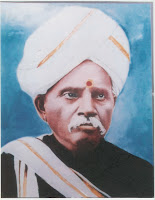
Mr Annaswamy had retired as the Joint Director of Town Planning in
the GoK and had written a book that was highly regarded, but here he
was generously giving of his time to a paltry freelance writer. He talked to me about his collage, helped me with photographs and entertained all my questions. I couldn't help but admire his humility and grace. I learnt about how RBANM could hobnob with Bowring and Sankey but never forgot his nationalist spirit, how he never forgot the help that the Maharaja gave him, how he argued for entry to temples for everyone fo all castes, how he had believed that wealth was something that was meant to be shared.

At the end of the interview, I came back impressed by one man, inspired by the other.

Wednesday, March 28, 2012

Why your grandma loves you

A good deal of my interest in science (in topics other than ecology, I mean) dates back to the time I was working on my doctoral dissertation. When staring at graph after graph became too much, or when I had just managed to hammer out another paragraph full of et al-s, howevers and therefores and really needed a break, my chosen method of chilling out was to browse science journals! I read up all the latest research on pesticide residues, acrylamide in foods, chimp behaviour, cooking oils, vitamin D, and sundry other topics in science. 
That was when I first read about, and was immediately intrigued by, the Grandmother Hypothesis. Since those early days, there has been a lot more written on that subject, including some pretty nice refinements that are stunning simple but exciting in how much they explain. The hypothesis - which includes explanations for why women undergo menopause and why grandmas dote on their grandchildren - had been on my mind a lot lately. When I found myself explaining it to a friend the other day, I decided it was high time I got it out of my system. This week's S and T section in Spectrum carries an article on the hypothesis:


What do women, whales and elephants have in common? Answer: The irreversible cessation of fertility that occurs well in advance of the end of the average adult life span.Or in plain English: menopause. In all the animal kingdom, only some kinds of whales, Asian elephants and women go through menopause. Naturally, scientists have long pondered over why this might be. And funnily enough, your grandmother might have a lot to do with this mystery.

You can read the rest of the article here.

Thursday, February 16, 2012

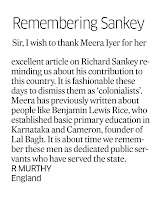
Sankey and a letter

I have always wanted to write about Richard Hieram Sankey - he of Sankey Tank fame - someone who seemed to me to be an epitome of industry. In a few short years, he built so many of our most beautiful buildings, including the lovely St. Andrews Church and the stately Mayo Hall. And of course, he was responsible for Cubbon Park. Who in Bangalore has not communed with Nature when wandering the winding paths that lead through its bamboo thickets, or listening to the trill of a magpie robin on one of its many trees. What impressed me about him was that he was not just a regular PWD engineer whose job it was to build edifices. That he did, but he was also clearly so passionate about a great many
other things. Look at his paintings and it is immediately obvious that he was a keen observer of Nature. In fact, he was one of the first to raise his voice against indiscriminate tree clearing in Coorg. While involved in work on building roads and bridges there, the ever-observant Sankey realised that tree felling led to flooding. He also collected fossils and shells. Sankey's first wife, Sophie Mary, was the daughter of the noted malachologist William Benson. Was Sankey interested in shells even before he met Sophie, I wonder...


Nothing quite compares to the high that appreciation brings. A day after my article on Sankey appeared in Deccan Herald, the main paper carried a letter from a reader who liked the article. I confess I couldn't stop smiling all day!

Monday, August 1, 2011

Bidriware... and a result

I was never a big fan of Bidriware - those highly polished black items with silver inlay that you can see at Cauvery. Sure, they looked nice. Would I buy one? Probably not. But a few weeks ago, I had the opportunity of interacting with some Bidriware artisans and that changed things somewhat.

One of the artisans I met was the genial, quick-witted and eminently likable Rasheed Qadri, a craftsperson who has won state and national awards for his work. "Awards get me recognition, not money," was one of his quotable quotes. He very patiently showed us the various steps that are involved in crafting these beautiful objets d'art. And as he wisely said, sometimes you can only appreciate something when you know it and understand it a little.

Although I do enjoy writing, sometimes I wonder if what I write serves any purpose at all. S often tells me writing is a complete waste of time and that it is only for hot-air types. I usually disagree but sometimes, I do get my doubts: does anyone ever read something I've written and maybe change their mind about some issue? Or perhaps they go out and do something that will make the world a better place, even if only for a few people, even if only in a very, very small way? Well, last week, after my article on Bidri appeared in Deccan Herald, I got an email from someone who said she had been in the handicrafts business for two decades. She said she used to sell Bidriware until her supplier suddenly stopped. "Seeing your article in the paper, I had to contact you to bring back this beautiful artwork into my showroom," she said. It's not much, I know, but at least one artisan will benefit from my writing. I'm moderately pleased.

Thursday, June 2, 2011

Begur again

Begur beguiles. Or perhaps it is more correct to say I find Begur beguiling. Perhaps it is the cute little mud fort that still stands bravely against all the construction cranes that are inching ever closer. Or perhaps it is how vestiges of the past are sprinkled all around the village in the form of statues, broken idols and pillars. Or perhaps it is the people who seem ever ready to share a story with you every time you visit. And then of course, there is the Bangalore inscription (which I wrote about a while ago). Luckily, it is still standing. Like I've said here, all it needs is a small open-air museum where it could be placed along with some information about its importance. Incredible how even getting such a little thing done is so difficult. In the meantime, the temple's four new gopuras are coming up at a brisk pace.

Lakshmi Sharath also has a nice write-up on Begur in the this week's Spectrum.

Tuesday, March 22, 2011

Cannon and fodder at the Battle of Bangalore

It's been a while since I posted here, mainly because I have been travelling a lot. But I couldn't pass up writing about the Battle of Bangalore on its 220th anniversary.
Did you know there was such a battle? Why, our very own fort was at the heart of things then. Bastions and breaches, bullocks and the British, cannon and fodder, bayonets and betrayals: the Battle of Bangalore had all the drama, blood and gore associated with battles. It was a short battle, with the siege lasting only two weeks. But the consequences were pretty far-reaching, or at least I like to think so. After all, capturing Bangalore made the assault on Srirangapatna (and hence the eventual defeat of Tipu) possible. Here's more on the Battle in my article in Deccan Herald.

Monday, December 13, 2010

The granddaddy of inscriptions

Q: What do you call a man who was teacher, Principal, administrator (all before he turned 30), census officer, prolific author, historian, polyglot and archaeologist all rolled into one? A: The granddaddy of inscriptions, aka, Benjamin Lewis Rice.

There isn't a historian in Karnataka (amateur or otherwise) who has not repeatedly reached for books by Benjamin Lewis Rice, his best known being the Gazetteers and the many volumes of Epigraphia carnatica which carry translations of thousands of old inscriptions.

But the history of the man who uncovered so much of our history is also fascinating. School principal at 23, Inspector of Schools (for the whole state, mind you!) at 28, Director of Public Instruction (again, for all of Mysore) at 31.... I could feel feelings of inadequacy creeping up on me, reading about Rice! And what an adventurous life he led, full of the thrill of discovery! The man spent at least half the year on tour ferreting out historical relics and obscure inscriptions from all around Karnataka, braving cobras, disease and goodness knows what else along the way. Remember, this was the pre-automobile era so all touring was done on horseback, or ponyback to be precise, for Rice had a white pony that he took on all his tours.

He knew Kannada, of course, having been born in Bangalore, but he also studied Hindi and Sanskrit, and later picked up Tamil and Grantha when he found he needed these to study inscriptions.

You can hear Lewis Rice's love of all things related to Karnataka's history and heritage in his writings, even in the dry official reports. He writes with indignation about people destroying old sculptures and with irritation about some bumbling restoration efforts.

I visited the house where he lived last week. It's a beautiful bungalow, well-maintained, set in a sprawling garden, with giant, stately trees. But the present owner wants nothing to do with Rice or his memories. "That was all so long ago," she kept saying.

You can read more about Lewis Rice in today's Spectrum supplement in Deccan Herald which carries an article on him that I wrote recently.


Wednesday, November 24, 2010

On John Cameron, a Prince and a scandal

Lalbagh has a special place in my heart, just as I suspect it does in the hearts of most Bangaloreans. I'm always amazed at just how many people have shaped this park. Hyder Ali and Tipu Sultan, of course, established the formal gardens. But so many people have since done their mite and left their stamp on this verdant space: Black, New, John Cameron, Gustav Krumbiegel, HC Javaraya, MH Marigowda to name to the well-known ones. But even though we know that all these men worked passionately and ceaselessly on our beloved park, we knew precious little about the men themselves, especially the earlier ones.

Take John Cameron, for instance (you can read more about him in my article that was published yesterday). He was one of those men who seems to have been able to squeeze 28 hours of work into 24. There is a popular story told of his efforts to popularise chow chow (aka seeme badanekai, Bangalore kattrikai, chayote, Sechium edule) in and around Bangalore. I could just imagine him riding about the countryside on his horse, urging farmers to try out the new crop. But I wonder what made him come to India... What did he do when he went back to England? Where did he stay when in Bangalore? And what about his family? His children and his wife?

John Cameron is the one who had the idea of a conservatory in Lalbagh. Its foundation stone was laid in 1889 by Prince Albert Victor (yes, that's why we have an Albert Victor Road in Bangalore), a grandson of Queen Vikki, and heir to the Prince of Wales, who himself was heir to the throne. This is why the conservatory was for a while known as the Albert Victor Hall or Albert Victor Conservatory. We, of course, know it as the Glass House.

Incidentally, Prince Albert Victor was embroiled in a a salacious scandal back home just before he came to India. There were rumours (now known to be all false) that he had been involved in 'acts of gross indecency' and 'buggery'. The whole India trip must have been such a welcome breather for the poor chap. He managed to live down the scandal but he never made it to the throne. He died of the flu just three years after his visit to India.

Monday, November 1, 2010

Heat, dust and Gulbarga

I'm always amazed at how, no matter in which direction you go, our country has all these little historic gems just waiting to be discovered. Take Gulbarga for instance. The name always brought to mind heat, aridity, dust and little else. Luckily, we live and we learn, for I now know that Gulbarga is actually home to an astonishing number of historic treasures. And the best part is that many of the buildings in the town are truly one of a kind.

Take the Jami Masjid, for instance, a building that historians and architects have waxed eloquent over for decades. It has a unique plan, a kind that you don't see anywhere else in the country. Or the Bala Hissar. Again, the building is the only one of its kind in India.

And yet, when my colleague and I asked our taxi driver to take us to the Gulbarga fort, his response was: "Why do you want to go there? It's a big, dirty, old ruin with nothing in it. Why don't you go see the new Buddha Vihar instead?" Well, we did actually make it to the fort, despite our taxi driver's best efforts. You can read a little more about the fort and a few of the other heritage buildings in Gulbarga in my article in today's Deccan Herald.

I was in Gulbarga for only a short while, certainly not enough to explore all, or even most of it. I hope to go back soon to see and experience more of the town. But I'm glad we did make it to the dargah of the sufi saint Khwaja Bande Nawaz. We went there just before closing time. All the courtyards, the mosque and even the paths between them were all full of people (of all faiths). And yet, the atmosphere was one of sanctity and serenity.

Oh and just for the record, at least when I went, Gulbarga was neither hot nor dusty!

Saturday, September 25, 2010

Megaliths and more...

I was at Hirebenkal in north Karnataka three weeks ago. This is a little village that is a mere 35km from Hospet but miles away in terms of crowds, facilities, and even accessibility. In the middle of the hills near the village is a fascinating cluster of hundreds of megalithic monuments - different types of dolmens, cists (burial chambers) and cairns (stone circles), all set amidst the dramatic boulder-strewn landscape that is so characteristic of northern Karnataka. Earlier this week, I wrote a story for Deccan Herald on this place.

Overall, the site is still relatively undisturbed, perhaps because of a taboo among people in Hirebenkal against going there. But clearly, the taboo is not widespread, for we met people from neighbouring villages who regularly bring their goats and cows here for grazing. It made for an interesting sight, seeing cows grazing amongst 2000-year-old megaliths... Only in India!

Of course, the feeling that the site had been untouched all those years was only an illusion. The picture on the right is of a cist, recently dug up by people who thought they would find treasure buried in it.

Hirebenkal is also chock-full of rock art - paintings done by the ancients on rocks in the area, showing deer, people, geometric designs, etc. More on that in a later post.

Monday, July 19, 2010

The one and only Ashoka

I happened to go to Koppal (in north Karnataka) a couple of months ago to see some Ashokan inscriptions maintained by ASI. As one who hated, nay abhorred, history in school, precious little of what I had 'by-hearted' about Ashoka remained in my memory - fought a war in Kalinga, was filled with remorse, converted to Buddhism, planted trees on roads.

There are two inscriptions at Koppal, one at Palkigundu and the other at Gavimath. You can barely make out the writing from the rock. And it doesn't help that at Palkigundu, some idiot has scribbled his name right on the inscription. But despite all that, the two 2300-year-old messages incised into the rocks stirred something in me. Not the usual All-hail-to-the-all-conquering-king. Nothing about the enemy submitting at the lotus feet of the ruler. Instead, a humble admission that he, Ashoka, had been a worshipper for a couple of years but had only applied himself for about a year, with dramatic results. And then an exhortation to all, whether exalted or not, to do the same so that "gods and men might mingle." In inscriptions elsewhere in the country, Ashoka talks of how he had given up military conquests and wanted only dhamma conquests! And all this because of a war.

Think about it. Have you heard of any other ruler in world history humane enough to recognise the costs of war and repent after one? I know of none. Not one. Even today, you still hear more of the "you're either with us or against us" kind of talk from world leaders, and only lip service, if at all, about the devastation brought about by war...

And talk about being progressive - Ashoka even had ministers for women's welfare!

So yes, as you can see, I came back from Koppal with an addition to my list of favourite people in Indian history!

Palkigundu is beautiful, by the way: hills, goats, goatherds, one dog, birds, quiet all along the way; and history waiting at the end of a lovely trek. What more could one ask for?

Today's Deccan Herald has my article on the Ashokan edicts at Koppal and Maski.

Tuesday, June 8, 2010

Lalbagh again

What a coincidence, and an unpleasant one, too. Soon after I wrote that article on Tipu's gardens for Deccan Herald a few weeks ago, the Horticulture Dept announced a slew of proposals for one of his gardens - Lalbagh. And what ill-thought out proposals they are!! A musical fountain, and a laser show to name a few. Apparently, they were impressed by what they saw in Singapore's Sentosa Island and want to recreate that look here. As someone on Intach's Facebook page commented, we don't want the Sentosa look, we want the Lalbagh look! And quite apart from questions of water shortage and maintenance of extravagances like musical fountains, have they thought about the effect laser shows will have on Lalbagh's birdlife?

And of course, there is the question of history! For more than 250 years, people have tended to the garden, adding to its wealth of trees. In 1891, when Lalbagh's area was just about 100 acres, it had 3,222 species of plants. Today, its area has more that doubled to 240 acres, but the number of species has decreased to 1,854. Isn't it obvious then where all or at least a part of that Rs. 84 crores should go? Into planting more trees, methinks.

More on Lalbagh in this article I wrote for Deccan Herald.

Monday, May 3, 2010

Tipu and his gardens

There was an item in the news recently about the State Forest Dept. seeking an amendment to the Karnataka Preservation of Trees Act (1976). (A big Thank You to Sheshadri of Hasiru Usiru for this information). The gist of the proposed amendment is that permission should not be required to cut trees of 42 species. Among the 42 species that the Forest Dept. wants people to be able to freely fell are beautiful and useful species such as neem, jackfruit, peepal, banyan, mango, tamarind and sheesham.

I couldn't help but contrast the cavalier attitude our administrators have towards trees with that of a ruler who died on this day 221 years ago: Tipu Sultan. Among his many proclamations was one that directed his amildars to try and plant 200 trees in every village. Another said people found guilty of minor offences could plant trees instead of paying a fine -- 2 mango and 2 jamun, to be looked after till they were of a certain height! There is also a story of how Tipu was thrilled to find a nutmeg tree during his capture of the fort of Cochin: here was one of the species he had been seeking to introduce, for it was not found in his kingdom. Tipu had the tree carefully uprooted, wrapped in rice straw and transported to one of his gardens in Srirangapatna. The tree died unfortunately. But some of the nutmeg and clove seedlings that he asked his ambassadors to bring back from Mauritius and elsewhere survived. Some of those were probably planted in Lalbagh too.

The next time you enjoy the peace and quiet of a morning walk in Lalbagh, spare a thought for one of the men who made it possible.

For more on Tipu and his gardens, read this published in today's Deccan Herald.

Tuesday, January 5, 2010

Bidar

I always thought of Bidar as a hot and dusty, centre-of-remoteness kind of place ...I shudder at my ignorance now. For Bidar is really a must-visit kind of place for any heritage enthusiast, teeming with diverse architectural and cultural remnants that mirror its chequered history.

And there is no better place to start than in its sprawling, huge, grand fort that is full of palaces, halls, wells, underground chambers and other nooks and crannies just asking to be explored.

Check out the massive fort walls and the one-of-a-kind triple moat.

The picture below was taken behind the Gagan Mahal, where you can find exciting underground rooms and passages that seem straight out of Famous Five.


Today's Deccan Herald has an article on Bidar that I wrote recently. A rather nice way to start the new year, I must say - having one of your articles published in the first week of January!