I happened to go to Koppal (in north Karnataka) a couple of months ago to see some Ashokan inscriptions maintained by ASI. As one who hated, nay abhorred, history in school, precious little of what I had 'by-hearted' about Ashoka remained in my memory - fought a war in Kalinga, was filled with remorse, converted to Buddhism, planted trees on roads.
There are two inscriptions at Koppal, one at Palkigundu and the other at Gavimath. You can barely make out the writing from the rock. And it doesn't help that at Palkigundu, some idiot has scribbled his name right on the inscription. But despite all that, the two 2300-year-old messages incised into the rocks stirred something in me. Not the usual All-hail-to-the-all-conquering-king. Nothing about the enemy submitting at the lotus feet of the ruler. Instead, a humble admission that he, Ashoka, had been a worshipper for a couple of years but had only applied himself for about a year, with dramatic results. And then an exhortation to all, whether exalted or not, to do the same so that "gods and men might mingle." In inscriptions elsewhere in the country, Ashoka talks of how he had given up military conquests and wanted only
dhamma conquests! And all this because of a war.
Think about it. Have you heard of any other ruler in world history humane enough to recognise the costs of war and repent after one? I know of none. Not one. Even today, you still hear more of the "you're either with us or against us" kind of talk from world leaders, and only lip service, if at all, about the devastation brought about by war...
And talk about being progressive - Ashoka even had ministers for women's welfare!
So yes, as you can see, I came back from Koppal with an addition to my list of favourite people in Indian history!
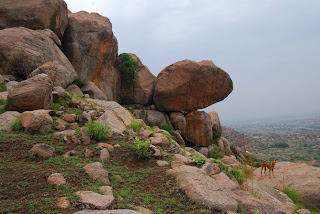
Palkigundu is beautiful, by the way: hills, goats, goatherds, one dog, birds, quiet all along the way; and history waiting at the end of a lovely trek. What more could one ask for?
Today's Deccan Herald has my
article on the Ashokan edicts at Koppal and Maski.


 Scholars have described the grid as being laid with almost mathematical precision, and standing next to one, I could see what they meant. Boulders neatly arranged in straight lines and diagonals stretched out in every direction, but for a few odd ones that seemed to have been slightly displaced. This was the site of Vibhutihalli, where some 3400 to 3800 years ago, ancient people painstakingly created this stone grid to serve as a sort of calendar in stone.
  Overall, the site is still relatively undisturbed, perhaps because of a taboo among people in Hirebenkal against going there. But clearly, the taboo is not widespread, for we met people from neighbouring villages who regularly bring their goats and cows here for grazing. It made for an interesting sight, seeing cows grazing amongst 2000-year-old megaliths... Only in India!
 Of course, the feeling that the site had been untouched all those years was only an illusion. The picture on the right is of a cist, recently dug up by people who thought they would find treasure buried in it.
 So yes, as you can see, I came back from Koppal with an addition to my list of favourite people in Indian history!