I had the pleasure of working on a project for the Archaeological Survey of India at Chitradurga recently: some colleagues and I installed some heritage interpretation panels there. What a vast and impressive fort this is!
On one of our visits, hubby and I managed to get to the fort at the unearthly hour of 6:00 am! And incredibly, we were not the only ones hanging about there, waiting for the gates to open. There was actually a rather interesting motley crowd, made up of two sleepy tourists (that's us), a lot of barefoot sari-clad women and dhoti-clad men - these were devotees who come to pray at the temple's many forts - and then there was a group of men in sneakers and shorts. It was only when we reached the Hidimbeshvara temple at the top of the fort that we realised what this last bunch was there for...Let me put it this way: who would want to work out in a stuffy old gym, when you could instead exercise in the brisk, invigorating air, in front of a 1000-year-old temple in a medieval fort atop a hill with a glorious view of a pink sunrise?
Apart from the many visits to the fort (which, of course, were the best parts of the project!), I really enjoyed researching this fascinating fort - its history, its design, its water-harvesting systems, its battles, the redoubtable Onake Obavva...
Of course, only a fraction of all this made it into our interpretation panels.
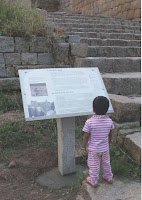
Here are some photos of our panels. We wanted the panels to have a strong visual element so that people could have something to look at as well as read.
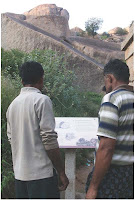
The panels are all at waist height so that they are easy to read for adults, but can be read by children too. We've also kept the language simple so that anyone who has studied up to the 6th or 7th Std can read and understand the panels.
If you have been to Chitradurga recently and have seen our panels, I would love to know what you thought of them. And if you haven't been to Chitradurga, well, what are you waiting for?


 Here are some photos of our panels. We wanted the panels to have a strong visual element so that people could have something to look at as well as read.
  The panels are all at waist height so that they are easy to read for adults, but can be read by children too. We've also kept the language simple so that anyone who has studied up to the 6th or 7th Std can read and understand the panels.