Monday, April 19, 2010
World Heritage Day
What a week! One heritage walk to organise and another to prepare for, an INTACH panel discussion to help organise, an article to edit for a friend and two to write. Aargh. Anyway, it all happened, goodness knows how. The INTACH-NGMA heritage walk at the Bangalore Fort was the most fun, the Deccan Herald article (which I had to put together with just about a day's notice) the least. Anyway, here is a link to the article.

Thursday, March 11, 2010
Lakkundi
I was in Lakkundi (12 km from Gadag, about 60 km from Hubli) a few weeks ago - hot, dusty, typically bucolic, incredibly charming.
This picture was taken at the Manikeshvara temple, my favourite spot in Lakkundi (it is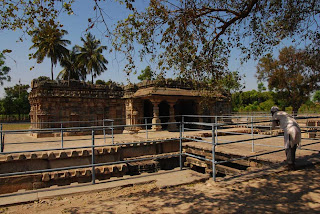 actually just outside it). The temple is in a small clearing in the midst of trees, and is utterly empty of people. Well, almost. The solitude, peace and quiet, and the large sheltering trees make this an ideal spot to contemplate on the higher things in life, as this man seems to be doing.
The railings that you see the man leaning against are along the Musukinabavi, one of the most beautiful kalyanis I have seen in Karnataka. It has a rather unusual design, complete with an underpass - no, not the ugly variety that you see on Bangalore' s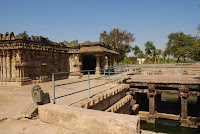 roads, but a rather elegant design. A 'bridge' leads from the temple to where the man is standing. Under this is another 'bridge' - a set of beams that connects chambers (changing rooms?) on two sides of the tank. Underneath both these bridges is a long flight of steps leading to the water. There are small decorative shrines all around the kalyani's steps.
There are other interesting temples in Lakkundi - some with only walls, some with nothing more than a linga left, the rest having long been absorbed into adjacent dwellings. The small square houses, with their white plastered walls contrasting with the deep blue of the sky, reminded me of photos of Majorca. Of course, to my (admittedly biased) eyes, I found Lakkundi much more appealing, what with its cows lounging in the shade, its brightly painted wooden carts, the old men sitting on their haunches watching me...
Lakkundi has a shepherding community who make blankets and durries. I was on a tight schedule on this visit (on a project for the Archaeological Survey of India) and so didn't get to chat with too many people this time. That will have to wait for the next time...
UPDATE:
Today's Deccan Herald has an article I wrote on Lakkundi.
This picture was taken at the Manikeshvara temple, my favourite spot in Lakkundi (it is
 actually just outside it). The temple is in a small clearing in the midst of trees, and is utterly empty of people. Well, almost. The solitude, peace and quiet, and the large sheltering trees make this an ideal spot to contemplate on the higher things in life, as this man seems to be doing.
The railings that you see the man leaning against are along the Musukinabavi, one of the most beautiful kalyanis I have seen in Karnataka. It has a rather unusual design, complete with an underpass - no, not the ugly variety that you see on Bangalore' s
 roads, but a rather elegant design. A 'bridge' leads from the temple to where the man is standing. Under this is another 'bridge' - a set of beams that connects chambers (changing rooms?) on two sides of the tank. Underneath both these bridges is a long flight of steps leading to the water. There are small decorative shrines all around the kalyani's steps.
There are other interesting temples in Lakkundi - some with only walls, some with nothing more than a linga left, the rest having long been absorbed into adjacent dwellings. The small square houses, with their white plastered walls contrasting with the deep blue of the sky, reminded me of photos of Majorca. Of course, to my (admittedly biased) eyes, I found Lakkundi much more appealing, what with its cows lounging in the shade, its brightly painted wooden carts, the old men sitting on their haunches watching me...
Lakkundi has a shepherding community who make blankets and durries. I was on a tight schedule on this visit (on a project for the Archaeological Survey of India) and so didn't get to chat with too many people this time. That will have to wait for the next time...
UPDATE:
Today's Deccan Herald has an article I wrote on Lakkundi.
Sunday, February 28, 2010
Ah Chitradurga!
I had the pleasure of working on a project for the Archaeological Survey of India at Chitradurga recently: some colleagues and I installed some heritage interpretation panels there. What a vast and impressive fort this is!
On one of our visits, hubby and I managed to get to the fort at the unearthly hour of 6:00 am! And incredibly, we were not the only ones hanging about there, waiting for the gates to open. There was actually a rather interesting motley crowd, made up of two sleepy tourists (that's us), a lot of barefoot sari-clad women and dhoti-clad men - these were devotees who come to pray at the temple's many forts - and then there was a group of men in sneakers and shorts. It was only when we reached the Hidimbeshvara temple at the top of the fort that we realised what this last bunch was there for...Let me put it this way: who would want to work out in a stuffy old gym, when you could instead exercise in the brisk, invigorating air, in front of a 1000-year-old temple in a medieval fort atop a hill with a glorious view of a pink sunrise?
Apart from the many visits to the fort (which, of course, were the best parts of the project!), I really enjoyed researching this fascinating fort - its history, its design, its water-harvesting systems, its battles, the redoubtable Onake Obavva...
Of course, only a fraction of all this made it into our interpretation panels.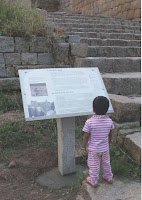 Here are some photos of our panels. We wanted the panels to have a strong visual element so that people could have something to look at as well as read.
 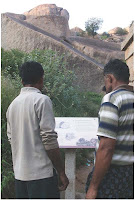 The panels are all at waist height so that they are easy to read for adults, but can be read by children too. We've also kept the language simple so that anyone who has studied up to the 6th or 7th Std can read and understand the panels.
If you have been to Chitradurga recently and have seen our panels, I would love to know what you thought of them. And if you haven't been to Chitradurga, well, what are you waiting for?
On one of our visits, hubby and I managed to get to the fort at the unearthly hour of 6:00 am! And incredibly, we were not the only ones hanging about there, waiting for the gates to open. There was actually a rather interesting motley crowd, made up of two sleepy tourists (that's us), a lot of barefoot sari-clad women and dhoti-clad men - these were devotees who come to pray at the temple's many forts - and then there was a group of men in sneakers and shorts. It was only when we reached the Hidimbeshvara temple at the top of the fort that we realised what this last bunch was there for...Let me put it this way: who would want to work out in a stuffy old gym, when you could instead exercise in the brisk, invigorating air, in front of a 1000-year-old temple in a medieval fort atop a hill with a glorious view of a pink sunrise?
Apart from the many visits to the fort (which, of course, were the best parts of the project!), I really enjoyed researching this fascinating fort - its history, its design, its water-harvesting systems, its battles, the redoubtable Onake Obavva...
Of course, only a fraction of all this made it into our interpretation panels.
 Here are some photos of our panels. We wanted the panels to have a strong visual element so that people could have something to look at as well as read.
  The panels are all at waist height so that they are easy to read for adults, but can be read by children too. We've also kept the language simple so that anyone who has studied up to the 6th or 7th Std can read and understand the panels.
If you have been to Chitradurga recently and have seen our panels, I would love to know what you thought of them. And if you haven't been to Chitradurga, well, what are you waiting for?
Tuesday, January 5, 2010
Bidar
I always thought of Bidar as a hot and dusty, centre-of-remoteness kind of place ...I shudder at my ignorance now. For Bidar is really a must-visit kind of place for any heritage enthusiast, teeming with diverse architectural and cultural remnants that mirror its chequered history.
 And there is no better place to start than in its sprawling, huge, grand fort that is full of palaces, halls, wells, underground chambers and other nooks and crannies just asking to be explored.
Check out the massive fort walls and the one-of-a-kind triple moat.
The picture below was taken behind the Gagan Mahal, where you can find exciting underground rooms and passages that seem straight out of Famous Five.
Today's Deccan Herald has an article on Bidar that I wrote recently. A rather nice way to start the new year, I must say - having one of your articles published in the first week of January!
 And there is no better place to start than in its sprawling, huge, grand fort that is full of palaces, halls, wells, underground chambers and other nooks and crannies just asking to be explored.
Check out the massive fort walls and the one-of-a-kind triple moat.

The picture below was taken behind the Gagan Mahal, where you can
 find exciting underground rooms and passages that seem straight out of Famous Five.
Today's Deccan Herald has an article on Bidar that I wrote recently. A rather nice way to start the new year, I must say - having one of your articles published in the first week of January!
Monday, December 7, 2009
The Bangalore Inscription
Today's Deccan Herald carries my article on Begur and the 9th century inscription that mentions Bengaluru. I like their title for the article: Here lies the Bengaluru inscription.
Incidentally, INTACH had a Parichay to Begur last Sunday. We had a very enthusiastic of people, with a good sprinkling of architects this time, for some reason. Dr Jegannathan gave an interesting and intriguing talk on energy zones and everyone was most interested in the Lecher antenna and how he uses it. Dr SK Aruni of the Indian Council of Historical Research was there as a participant, but was quite happy to speak to the group about Begur. As always, he impressed everyone with his phenomenal knowledge - on the temple, hero-stones, Bangalore...The most exciting part of his talk for me was when he pronounced the potsherds that I had collected on a previous trip as being quite old - 2000 years old or thereabouts!
The good news is that the temple trustees, who also came to listen to the talks, were quite keen on preserving the inscriptions, especially the one that talks about Bengaluru now that they know what it means and what it stands for.
Incidentally, INTACH had a Parichay to Begur last Sunday. We had a very enthusiastic of people, with a good sprinkling of architects this time, for some reason. Dr Jegannathan gave an interesting and intriguing talk on energy zones and everyone was most interested in the Lecher antenna and how he uses it. Dr SK Aruni of the Indian Council of Historical Research was there as a participant, but was quite happy to speak to the group about Begur. As always, he impressed everyone with his phenomenal knowledge - on the temple, hero-stones, Bangalore...The most exciting part of his talk for me was when he pronounced the potsherds that I had collected on a previous trip as being quite old - 2000 years old or thereabouts!
The good news is that the temple trustees, who also came to listen to the talks, were quite keen on preserving the inscriptions, especially the one that talks about Bengaluru now that they know what it means and what it stands for.
Sunday, November 15, 2009
Parichay to Begur
INTACH Bangalore invites you to a Parichay to Begur.
Begur has a special place in Bangalore's history - the name Bangalore first appears in a 1100-year-old inscription found at the Panchalingeshwara temple here.
This ancient temple is a fitting venue to learn about the concept of energy zones in traditional Indian architecture from Dr R Jegannathan, who will demonstrate how to measure energy fields and speak about them in his talk, "Ancient Wisdom - A Pathway to Modern & Sustainable Living". We will also explore the history of the temple and the settlement around it.
When: 8:30 am on Sunday, 29 Nov 2009
Where: Panchalingeshwara temple, Begur
Directions: Head south on Hosur Road towards Bommanahalli. At Bommanahalli junction, turn right onto Begur road. The Panchalingeswara temple is on Begur Road, 3.6 km off Hosur Road.
There is a fee of Rs 100 for this event. Seats are limited, so please call ahead to register. For registration and more information, call: 9986023014.
Begur has a special place in Bangalore's history - the name Bangalore first appears in a 1100-year-old inscription found at the Panchalingeshwara temple here.
This ancient temple is a fitting venue to learn about the concept of energy zones in traditional Indian architecture from Dr R Jegannathan, who will demonstrate how to measure energy fields and speak about them in his talk, "Ancient Wisdom - A Pathway to Modern & Sustainable Living". We will also explore the history of the temple and the settlement around it.
When: 8:30 am on Sunday, 29 Nov 2009
Where: Panchalingeshwara temple, Begur
Directions: Head south on Hosur Road towards Bommanahalli. At Bommanahalli junction, turn right onto Begur road. The Panchalingeswara temple is on Begur Road, 3.6 km off Hosur Road.
There is a fee of Rs 100 for this event. Seats are limited, so please call ahead to register. For registration and more information, call: 9986023014.
Tuesday, November 10, 2009
Mystery of the sands
For a really unique mix of history, mystery, archaeology and a lovely dose of nature, you can do no better than head to Talakad (variously spelt as Talakkad, Talkad and Talakadu).
Talakad is an ancient town, dating back to at least 2000 years ago, judging by megalithic remains found here. In the early 1600s, Alamelamma, wife of the defeated Vijayanagar viceroy jumped into the river Cauvery here, but not before famously cursing the Mysore Wodeyar dynasty and the town of Talakad itself. You can see a documentary made by Sashi Sivramkrishna about the curse here. Of course, what is really intriguing about the story of the curse is how it seems to have come true. Many Wodeyar kings have indeed not borne male heirs and have had to adopt to continue their line; and the town of Talakad has indeed been deluged by sand.
So what does the scientific community have to say about this remarkable coincidence? Check out my article in today's Deccan Herald about this. I had a good time researching this article, including an enjoyable talk with MB Rajani, a postdoc at NIAS.
Today, most people know of Talakad either as a place of pilgrimage, for the Panchalinga darshana that is held here (to be held next week), or as a picnic spot, to frolic in the sun and sands along the Cauvery. But the next time you visit there, take time to go off the beaten track to see signs of the city (or cities?) that lies buried beneath the sand under your feet. Trust me, you can see them...
Talakad is an ancient town, dating back to at least 2000 years ago, judging by megalithic remains found here. In the early 1600s, Alamelamma, wife of the defeated Vijayanagar viceroy jumped into the river Cauvery here, but not before famously cursing the Mysore Wodeyar dynasty and the town of Talakad itself. You can see a documentary made by Sashi Sivramkrishna about the curse here. Of course, what is really intriguing about the story of the curse is how it seems to have come true. Many Wodeyar kings have indeed not borne male heirs and have had to adopt to continue their line; and the town of Talakad has indeed been deluged by sand.
So what does the scientific community have to say about this remarkable coincidence? Check out my article in today's Deccan Herald about this. I had a good time researching this article, including an enjoyable talk with MB Rajani, a postdoc at NIAS.
Today, most people know of Talakad either as a place of pilgrimage, for the Panchalinga darshana that is held here (to be held next week), or as a picnic spot, to frolic in the sun and sands along the Cauvery. But the next time you visit there, take time to go off the beaten track to see signs of the city (or cities?) that lies buried beneath the sand under your feet. Trust me, you can see them...
Subscribe to:
Posts (Atom)