Did you know there was such a battle? Why, our very own fort was at the heart of things then. Bastions and breaches, bullocks and the British, cannon and fodder, bayonets and betrayals: the Battle of Bangalore had all the drama, blood and gore associated with battles. It was a short battle, with the siege lasting only two weeks. But the consequences were pretty far-reaching, or at least I like to think so. After all, capturing Bangalore made the assault on Srirangapatna (and hence the eventual defeat of Tipu) possible. Here's more on the Battle in my article in Deccan Herald.
Tuesday, March 22, 2011
Cannon and fodder at the Battle of Bangalore
It's been a while since I posted here, mainly because I have been travelling a lot. But I couldn't pass up writing about the Battle of Bangalore on its 220th anniversary.

Monday, December 13, 2010
The granddaddy of inscriptions
Q: What do you call a man who was teacher, Principal, administrator (all before he turned 30), census officer, prolific author, historian, polyglot and archaeologist all rolled into one? A: The granddaddy of inscriptions, aka, Benjamin Lewis Rice.
There isn't a historian in Karnataka (amateur or otherwise) who has not repeatedly reached for books by Benjamin Lewis Rice, his best known being the Gazetteers and the many volumes of Epigraphia carnatica which carry translations of thousands of old inscriptions.
But the history of the man who uncovered so much of our history is also fascinating. School principal at 23, Inspector of Schools (for the whole state, mind you!) at 28, Director of Public Instruction (again, for all of Mysore) at 31.... I could feel feelings of inadequacy creeping up on me, reading about Rice! And what an adventurous life he led, full of the thrill of discovery! The man spent at least half the year on tour ferreting out historical relics and obscure inscriptions from all around Karnataka, braving cobras, disease and goodness knows what else along the way. Remember, this was the pre-automobile era so all touring was done on horseback, or ponyback to be precise, for Rice had a white pony that he took on all his tours.
He knew Kannada, of course, having been born in Bangalore, but he also studied Hindi and Sanskrit, and later picked up Tamil and Grantha when he found he needed these to study inscriptions.
You can hear Lewis Rice's love of all things related to Karnataka's history and heritage in his writings, even in the dry official reports. He writes with indignation about people destroying old sculptures and with irritation about some bumbling restoration efforts.
I visited the house where he lived last week. It's a beautiful bungalow, well-maintained, set in a sprawling garden, with giant, stately trees. But the present owner wants nothing to do with Rice or his memories. "That was all so long ago," she kept saying.
You can read more about Lewis Rice in today's Spectrum supplement in Deccan Herald which carries an article on him that I wrote recently.
Wednesday, November 24, 2010
On John Cameron, a Prince and a scandal
Lalbagh has a special place in my heart, just as I suspect it does in the hearts of most Bangaloreans. I'm always amazed at just how many people have shaped this park. Hyder Ali and Tipu Sultan, of course, established the formal gardens. But so many people have since done their mite and left their stamp on this verdant space: Black, New, John Cameron, Gustav Krumbiegel, HC Javaraya, MH Marigowda to name to the well-known ones. But even though we know that all these men worked passionately and ceaselessly on our beloved park, we knew precious little about the men themselves, especially the earlier ones.
Take John Cameron, for instance (you can read more about him in my article that was published yesterday). He was one of those men who seems to have been able to squeeze 28 hours of work into 24. There is a popular story told of his efforts to popularise chow chow (aka seeme badanekai, Bangalore kattrikai, chayote, Sechium edule) in and around Bangalore. I could just imagine him riding about the countryside on his horse, urging farmers to try out the new crop. But I wonder what made him come to India... What did he do when he went back to England? Where did he stay when in Bangalore? And what about his family? His children and his wife?
John Cameron is the one who had the idea of a conservatory in Lalbagh. Its foundation stone was laid in 1889 by Prince Albert Victor (yes, that's why we have an Albert Victor Road in Bangalore), a grandson of Queen Vikki, and heir to the Prince of Wales, who himself was heir to the throne. This is why the conservatory was for a while known as the Albert Victor Hall or Albert Victor Conservatory. We, of course, know it as the Glass House.
Incidentally, Prince Albert Victor was embroiled in a a salacious scandal back home just before he came to India. There were rumours (now known to be all false) that he had been involved in 'acts of gross indecency' and 'buggery'. The whole India trip must have been such a welcome breather for the poor chap. He managed to live down the scandal but he never made it to the throne. He died of the flu just three years after his visit to India.
Take John Cameron, for instance (you can read more about him in my article that was published yesterday). He was one of those men who seems to have been able to squeeze 28 hours of work into 24. There is a popular story told of his efforts to popularise chow chow (aka seeme badanekai, Bangalore kattrikai, chayote, Sechium edule) in and around Bangalore. I could just imagine him riding about the countryside on his horse, urging farmers to try out the new crop. But I wonder what made him come to India... What did he do when he went back to England? Where did he stay when in Bangalore? And what about his family? His children and his wife?
John Cameron is the one who had the idea of a conservatory in Lalbagh. Its foundation stone was laid in 1889 by Prince Albert Victor (yes, that's why we have an Albert Victor Road in Bangalore), a grandson of Queen Vikki, and heir to the Prince of Wales, who himself was heir to the throne. This is why the conservatory was for a while known as the Albert Victor Hall or Albert Victor Conservatory. We, of course, know it as the Glass House.
Incidentally, Prince Albert Victor was embroiled in a a salacious scandal back home just before he came to India. There were rumours (now known to be all false) that he had been involved in 'acts of gross indecency' and 'buggery'. The whole India trip must have been such a welcome breather for the poor chap. He managed to live down the scandal but he never made it to the throne. He died of the flu just three years after his visit to India.
Thursday, November 18, 2010
Where the streets have names
iJanaagraha, the recently launched online portal of the NGO Janaagraha, last month asked for a short piece on street names. A bit of a coincidence, because a colleague and I had been wondering about some street names just a few days before that.
The article was quite fun to write, though a wee bit stressful, because of a short deadline (a perennial problem!). I would have liked to research some things a bit more so I'm not overly happy with the end result. But here it is on iJanaagraha.
Some of the street (and locality/park) names that didn't make it to the article: Coles Park and Cubbon Road and Park (after former British Residents, of course); Dobbspet - variously known as Daabspet, Dabbaspet etc. (after Major General RS Dobbs); Sajjan Rao Circle; Campbell Road (after a missionary); Hardinge Road (after a viceroy); and many, many more.
But there are hundreds more stories that I don't yet know, waiting to be found behind hundreds more streets...
The article was quite fun to write, though a wee bit stressful, because of a short deadline (a perennial problem!). I would have liked to research some things a bit more so I'm not overly happy with the end result. But here it is on iJanaagraha.
Some of the street (and locality/park) names that didn't make it to the article: Coles Park and Cubbon Road and Park (after former British Residents, of course); Dobbspet - variously known as Daabspet, Dabbaspet etc. (after Major General RS Dobbs); Sajjan Rao Circle; Campbell Road (after a missionary); Hardinge Road (after a viceroy); and many, many more.
But there are hundreds more stories that I don't yet know, waiting to be found behind hundreds more streets...
Monday, November 1, 2010
Heat, dust and Gulbarga
I'm always amazed at how, no matter in which direction you go, our country has all these little historic gems just waiting to be discovered. Take Gulbarga for instance. The name always brought to mind heat, aridity, dust and little else. Luckily, we live and we learn, for I now know that Gulbarga is actually home to an astonishing number of historic treasures. And the best part is that many of the buildings in the town are truly one of a kind.
Take the Jami Masjid, for instance, a building that historians and architects have waxed eloquent over for decades. It has a unique plan, a kind that you don't see anywhere else in the country. Or the Bala Hissar. Again, the building is the only one of its kind in India.
And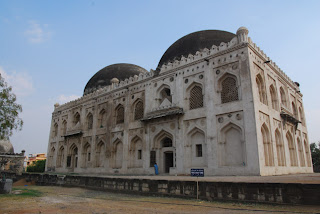 yet, when my colleague and I asked our taxi driver to take us to the Gulbarga fort, his response was: "Why do you want to go there? It's a big, dirty, old ruin with nothing in it. Why don't you go see the new Buddha Vihar instead?" Well, we did actually make it to the fort, despite our taxi driver's best efforts. You can read a little more about the fort and a few of the other heritage buildings in Gulbarga in my article in today's Deccan Herald.
I was in Gulbarga for only a short while, certainly not enough to explore all, or even most of it. I hope to go back soon to see and experience more of the town. But I'm glad we did make it to the dargah of the sufi saint Khwaja Bande Nawaz. We went there just before closing time. All the courtyards, the mosque and even the paths between them were all full of people (of all faiths). And yet, the atmosphere was one of sanctity and serenity.
Oh and just for the record, at least when I went, Gulbarga was neither hot nor dusty!
Take the Jami Masjid, for instance, a building that historians and architects have waxed eloquent over for decades. It has a unique plan, a kind that you don't see anywhere else in the country. Or the Bala Hissar. Again, the building is the only one of its kind in India.
And
 yet, when my colleague and I asked our taxi driver to take us to the Gulbarga fort, his response was: "Why do you want to go there? It's a big, dirty, old ruin with nothing in it. Why don't you go see the new Buddha Vihar instead?" Well, we did actually make it to the fort, despite our taxi driver's best efforts. You can read a little more about the fort and a few of the other heritage buildings in Gulbarga in my article in today's Deccan Herald.
I was in Gulbarga for only a short while, certainly not enough to explore all, or even most of it. I hope to go back soon to see and experience more of the town. But I'm glad we did make it to the dargah of the sufi saint Khwaja Bande Nawaz. We went there just before closing time. All the courtyards, the mosque and even the paths between them were all full of people (of all faiths). And yet, the atmosphere was one of sanctity and serenity.
Oh and just for the record, at least when I went, Gulbarga was neither hot nor dusty!
Saturday, September 25, 2010
Megaliths and more...
I was at Hirebenkal in north Karnataka three weeks ago. This is a little village that is a mere 35km from Hospet but miles away in terms of crowds, facilities, and even accessibility. In the middle of the hills near the village is a fascinating cluster of hundreds of megalithic monuments - different types of dolmens, cists (burial chambers) and cairns (stone circles), all set amidst the dramatic boulder-strewn landscape that is so characteristic of northern Karnataka. Earlier this week, I wrote a story for Deccan Herald on this place.
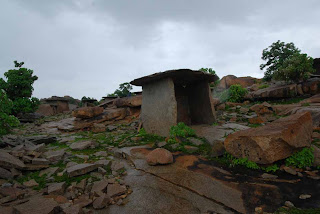 Overall, the site is still relatively undisturbed, perhaps because of a taboo among people in Hirebenkal against going there. But clearly, the taboo is not widespread, for we met people from neighbouring villages who regularly bring their goats and cows here for grazing. It made for an interesting sight, seeing cows grazing amongst 2000-year-old megaliths... Only in India!
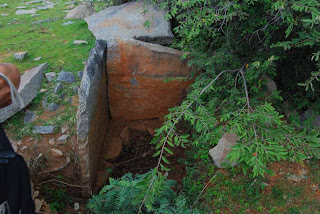 Of course, the feeling that the site had been untouched all those years was only an illusion. The picture on the right is of a cist, recently dug up by people who thought they would find treasure buried in it.
Hirebenkal is also chock-full of rock art - paintings done by the ancients on rocks in the area, showing deer, people, geometric designs, etc. More on that in a later post.
 Overall, the site is still relatively undisturbed, perhaps because of a taboo among people in Hirebenkal against going there. But clearly, the taboo is not widespread, for we met people from neighbouring villages who regularly bring their goats and cows here for grazing. It made for an interesting sight, seeing cows grazing amongst 2000-year-old megaliths... Only in India!
 Of course, the feeling that the site had been untouched all those years was only an illusion. The picture on the right is of a cist, recently dug up by people who thought they would find treasure buried in it.
Hirebenkal is also chock-full of rock art - paintings done by the ancients on rocks in the area, showing deer, people, geometric designs, etc. More on that in a later post.
Monday, August 23, 2010
Bus Day
Earlier this month, Bangalore Midday asked for a piece on lesser-known heritage spots in Bangalore that can be reached by Volvo buses. They published this on 4th August, Bus Day. A nice way of promoting the use of buses, I thought.
Here are some of the areas I wrote about for them.
Koramangala
If you know that Kempegowda founded the city of Bangalore, you’ve probably heard of the tragic tale of sacrifice associated with its establishment. The story goes that in 1537, when construction of Kempegowda’s fort was nearly complete, the king ran into a problem: each time the southern gate was constructed, it would collapse at night. Astrologers advised Kempegowda that a human sacrifice, especially of a pregnant woman, would solve the issue. But Kempegowda found this idea repugnant. Knowing her father-in-law’s predicament, Lakshmamma, Kempegowda’s pregnant daughter-in-law, decided to take matters into her hand and sacrificed herself to appease the gods. A distraught Kempegowda raised a temple dedicated to the courageous woman.
You can see this temple and a memorial associated with young lady in Koramangala 6th Block, near the Parikrama School. The temple has undergone extensive renovations and little remains to indicate its past history. The temple opens only on Friday mornings. The memorial lies in the pocket-sized Lakshmamma Park, half a kilometre from the temple. The BBMP-maintained park is also used as a burial ground.
Bus number: 411K
Lalbagh
“Lalbagh? Been there, done that,” you scoff. But this wonderful botanical garden has more than spectacular natural heritage to boast of. The best-known monuments in Lalbagh are probably the iconic Kempegowda tower atop the 3000 million-year-old Rock, and the Glass House, built in 1889-90. Lesser known heritage structures in the garden include the 150-year-old building that once served as the cottage of the superintendent and now houses the Lalbagh Library. Also dating from the same period are bandstand and the old now-ruined Lecture Hall, which still bears the double-headed eagle known as ganda bherunda, the crest of the Mysore Wodeyars. The guard room at the entrance of West Gate also has an interesting history. It originally stood in front of the house of Dewan Krishnamurthy. It was to be destroyed in the 1940s but was dismantled and shifted here in the 1940s by Sir Mirza Ismail and HC Javaraya, the then superintendent of Lalbagh.
Bus numbers: 2, 356 Q
Here are some of the areas I wrote about for them.
Koramangala
If you know that Kempegowda founded the city of Bangalore, you’ve probably heard of the tragic tale of sacrifice associated with its establishment. The story goes that in 1537, when construction of Kempegowda’s fort was nearly complete, the king ran into a problem: each time the southern gate was constructed, it would collapse at night. Astrologers advised Kempegowda that a human sacrifice, especially of a pregnant woman, would solve the issue. But Kempegowda found this idea repugnant. Knowing her father-in-law’s predicament, Lakshmamma, Kempegowda’s pregnant daughter-in-law, decided to take matters into her hand and sacrificed herself to appease the gods. A distraught Kempegowda raised a temple dedicated to the courageous woman.
You can see this temple and a memorial associated with young lady in Koramangala 6th Block, near the Parikrama School. The temple has undergone extensive renovations and little remains to indicate its past history. The temple opens only on Friday mornings. The memorial lies in the pocket-sized Lakshmamma Park, half a kilometre from the temple. The BBMP-maintained park is also used as a burial ground.
Bus number: 411K
Lalbagh
“Lalbagh? Been there, done that,” you scoff. But this wonderful botanical garden has more than spectacular natural heritage to boast of. The best-known monuments in Lalbagh are probably the iconic Kempegowda tower atop the 3000 million-year-old Rock, and the Glass House, built in 1889-90. Lesser known heritage structures in the garden include the 150-year-old building that once served as the cottage of the superintendent and now houses the Lalbagh Library. Also dating from the same period are bandstand and the old now-ruined Lecture Hall, which still bears the double-headed eagle known as ganda bherunda, the crest of the Mysore Wodeyars. The guard room at the entrance of West Gate also has an interesting history. It originally stood in front of the house of Dewan Krishnamurthy. It was to be destroyed in the 1940s but was dismantled and shifted here in the 1940s by Sir Mirza Ismail and HC Javaraya, the then superintendent of Lalbagh.
Bus numbers: 2, 356 Q
Subscribe to:
Posts (Atom)