Friday, July 6, 2012

A slice of Paradise

I can't remember the last time I enjoyed a hike as much. We were at Bhagamandala, in Coorg, where the river Cauvery is joined by the Kanika to create a sacred confluence. We had just been to the beautiful Bhagandeshwara temple and were now off to Talacauvery to see the source of south India's most sacred river. But rather than drive up, we decided to walk up. I had done this 6km walk before, but that was several years ago, when I had come with a group of friends from the mountaineering club SPARK. I had very fond memories of that short trek. Would things have changed now? 


Incredibly, it is as if the years in between never were. As before, we didn't meet a soul along the way. The moss- and fern-covered old stone steps were just as I had remembered and it was still a delight to walk along the tree-lined path that wound its way through orange plantations. And there near the top of the hill was top was the small stone Nandi, looking into the distance where the Talacauvery temple was. From that vantage point, we could see the Talacauvery gate and temple in the distance, partly shrouded in mist. We could also hear cars whizzing past us on the road below. I couldn't help but feel they were missing out on a small slice of paradise. 

Thursday, April 19, 2012

Heritage Interpretation

At Hirebenakal
Over the last year, I have been working on a clutch of heritage interpretation projects for the Archaeological Survey of India (ASI). Some of these were at some megalithic sites in north Karnataka, some at sites that have Ashokan inscriptions, and a recent set that I just finished was in Bhatkal and Mirjan in North Kanara. Here are pictures of some of the signs. Concept, research and writing by yours truly. Illustration and design by two gifted young women, Sneha Prasad and Nikita Jain.

At Hirebenakal

At the Ashokan edict site at Gavimath. That's a portrait of Ashoka there!
At Bhatkal 

Wednesday, March 28, 2012

Why your grandma loves you

A good deal of my interest in science (in topics other than ecology, I mean) dates back to the time I was working on my doctoral dissertation. When staring at graph after graph became too much, or when I had just managed to hammer out another paragraph full of et al-s, howevers and therefores and really needed a break, my chosen method of chilling out was to browse science journals! I read up all the latest research on pesticide residues, acrylamide in foods, chimp behaviour, cooking oils, vitamin D, and sundry other topics in science. 
That was when I first read about, and was immediately intrigued by, the Grandmother Hypothesis. Since those early days, there has been a lot more written on that subject, including some pretty nice refinements that are stunning simple but exciting in how much they explain. The hypothesis - which includes explanations for why women undergo menopause and why grandmas dote on their grandchildren - had been on my mind a lot lately. When I found myself explaining it to a friend the other day, I decided it was high time I got it out of my system. This week's S and T section in Spectrum carries an article on the hypothesis:


What do women, whales and elephants have in common? Answer: The irreversible cessation of fertility that occurs well in advance of the end of the average adult life span.Or in plain English: menopause. In all the animal kingdom, only some kinds of whales, Asian elephants and women go through menopause. Naturally, scientists have long pondered over why this might be. And funnily enough, your grandmother might have a lot to do with this mystery.

You can read the rest of the article here.

Sunday, March 11, 2012

The original Lalbagh

It all started almost two years ago, when the National Gallery of Modern Art, Bengaluru asked INTACH to organise some walks in Bangalore to coincide with an exhibition they were having on artists of the 1700s and 1800s. One of the walks we did then was at Lalbagh Botanical Garden.
I've always loved going to Lalbagh (except perhaps on some weekends when you can barely see the trees for the people). Researching the history of the garden for the Parichay was fun - re-reading Tipu's letters where he asks for seeds from elsewhere, reliving Cleghorn's excitement over the Sultan's garden that was to become a botanical garden...
But we had chosen Lalbagh for the NGMA walk because in the eighteenth century, a lot of Englishmen who came to Bangalore - soldiers, draughtsmen, artists - seem to have been fascinated by the place. In the late 1700s, Europe was in the grip of the Picturesque movement, so when artistically-inclined chaps came and saw here a readymade picturesque garden, complete with mandatory ruin, it was but natural that they tried to capture its picturesqueness in their sketches. Robert Home, James Hunter, Robert Colebrooke and Claude Martin all sketched views of Lalbagh.
Spurred on by MBK, I tried to take a closer look at the paintings and at maps that we had for the same period...and was a little startled. Why, it looked like today's Lalbagh was not where the Lalbagh of the 1790s was. A couple of emails to colleagues and friends who are considerably wiser than I, some meetings, a few discussions, and several months later, we had put together a note which was later published in Current Science. Take a look. And the next time you go to Lalbagh, think about how different it once looked.

Thursday, February 16, 2012

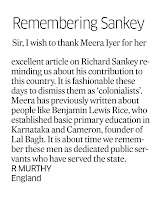
Sankey and a letter

I have always wanted to write about Richard Hieram Sankey - he of Sankey Tank fame - someone who seemed to me to be an epitome of industry. In a few short years, he built so many of our most beautiful buildings, including the lovely St. Andrews Church and the stately Mayo Hall. And of course, he was responsible for Cubbon Park. Who in Bangalore has not communed with Nature when wandering the winding paths that lead through its bamboo thickets, or listening to the trill of a magpie robin on one of its many trees. What impressed me about him was that he was not just a regular PWD engineer whose job it was to build edifices. That he did, but he was also clearly so passionate about a great many
other things. Look at his paintings and it is immediately obvious that he was a keen observer of Nature. In fact, he was one of the first to raise his voice against indiscriminate tree clearing in Coorg. While involved in work on building roads and bridges there, the ever-observant Sankey realised that tree felling led to flooding. He also collected fossils and shells. Sankey's first wife, Sophie Mary, was the daughter of the noted malachologist William Benson. Was Sankey interested in shells even before he met Sophie, I wonder...


Nothing quite compares to the high that appreciation brings. A day after my article on Sankey appeared in Deccan Herald, the main paper carried a letter from a reader who liked the article. I confess I couldn't stop smiling all day!

Monday, September 26, 2011

Bhatkal's alluring charm

A few weeks ago, I was in that most beautiful of regions, coastal Karnataka. WHAT a sight for sore eyes: mountains partially veiled by mists, vistas of various shades of green, and the almost-constant pitter-patter of life-giving rain. Shah Jahan had it wrong. If there is a heaven on earth, it is here, it is here, it is definitely here.

We were in Bhatkal, a quiet and charming little town full of beautiful old houses and handsome men and women. Yet who would have thought that five hundred years ago, this same town bustled with activity, being the mighty Vijayanagar Empire's principal port city?? Those were the good times for Bhatkal - business boomed, the economy flourished and money accumulated. Prosperity manifested itself in many ways. A number of large and grand temples and palaces were built in the town, most of them with donations from successful businessmen. The palaces are long gone but a few of the temples still survive. In fact, the very picturesque area of Mudbhatkal, a suburb about 2 km away from the main town, has a clutch of about 6 old temples, all situated in picture-postcard types of settings amidst paddy fields and coconut palms. Some like the Khetapai Narayana temple are fairly well-preserved, others like the Adikenarayana temple, are little more than partial walls and a roof. All are definitely worth a visit, especially the Adikenarayana and the Lakkar Kamti.

The only way to get to this last temple was by walking through the fields. It was quite an enchanting sight, a lone brown shrine marooned in a sea of waving paddy fields. I had assumed the temple was abandoned. Perhaps that is why I found a certain poignancy to the simple garland of white flowers draped around one of the idols. The temple might have been isolated but someone still took the trouble to adorn the idol everyday.

You can read a little more about Bhatkal and its temples in this article which appeared in Deccan Herald a few weeks ago.


Monday, August 1, 2011

Bidriware... and a result

I was never a big fan of Bidriware - those highly polished black items with silver inlay that you can see at Cauvery. Sure, they looked nice. Would I buy one? Probably not. But a few weeks ago, I had the opportunity of interacting with some Bidriware artisans and that changed things somewhat.

One of the artisans I met was the genial, quick-witted and eminently likable Rasheed Qadri, a craftsperson who has won state and national awards for his work. "Awards get me recognition, not money," was one of his quotable quotes. He very patiently showed us the various steps that are involved in crafting these beautiful objets d'art. And as he wisely said, sometimes you can only appreciate something when you know it and understand it a little.

Although I do enjoy writing, sometimes I wonder if what I write serves any purpose at all. S often tells me writing is a complete waste of time and that it is only for hot-air types. I usually disagree but sometimes, I do get my doubts: does anyone ever read something I've written and maybe change their mind about some issue? Or perhaps they go out and do something that will make the world a better place, even if only for a few people, even if only in a very, very small way? Well, last week, after my article on Bidri appeared in Deccan Herald, I got an email from someone who said she had been in the handicrafts business for two decades. She said she used to sell Bidriware until her supplier suddenly stopped. "Seeing your article in the paper, I had to contact you to bring back this beautiful artwork into my showroom," she said. It's not much, I know, but at least one artisan will benefit from my writing. I'm moderately pleased.